00:00
COVER
Hello!
oH radio is a sporadic radio platform of the MA in Graphic Design at the Estonian Academy of Art. It was initiated in 2021 by Paula Buškevica and has since gone through different iterations and activations.
It is a platform for explorations into different editorial methods and modes of making public.
This web-to-print publication understands itself as an attempt at a user guide for oH radio. Rather than calling itself a manual, a term commonly referring to an authoritative overview of the functionality of a specific piece of hard- or software, it is supposed to be a supporting document that facilitates activating and using the radio. The guide is also decidedly not meant to be static. Living inside a google document it is meant to be extended, changed, sampled and remixed and regenerated if needed.
It consists of 3 parts:
A remix reader, collecting some texts or fragments of texts that have been collected over the past two years and that have been, for different reasons, influential or informative for me.
A technical guide that hopefully will help anyone reading it put a radio show on the air and later into the archive.
An open-ended slide-show collecting works, projects and references that could be useful as jumping off points for future radio related projects, activities and research.
oH is a sound.
o is also a space.
It can be entered.
It seems that oH cannot stand by itself, but it can.
The o has the H to keep it from rolling.
H placed on top of each other forms a little ladder.
H makes connections and connections are rather important.
oH is currently run by Greta Þorkels & Michael Fowler.
Part of EKA GD MA, oH radio was initiated in 2021 by Paula Buškevica.
Website & logo by Alejandro Bellón Ample & Paula Buškevica.
it's oH radio not radio amateur gather point connecting activating sharing auditory carving an entrance point to real-time collective sonic journeys gather otherwise through ears open collecting producing a wide range jump poetry acoustic identity adventure movement ghosts being brave thinking field scan improvisation wellbeing making friendship informal sexy spontaneous ears unhinged
(from: 2022.oh.eka-gd-ma.ee)
within oh, there are two sattelites:
O(x) and Ore.
oH is currently run by Greta Þorkelsdóttir & Michael Fowler.
Part of EKA GD MA, oH radio was initiated in 2021 by Paula Buškevica.
Design:
Michael Fowler, Greta Þorkelsdóttir
Development:
Greta Þorkelsdóttir
The site is always under construction.
(from: 2023.oh.eka-gd-ma.ee)
**o** is a world. **o** is your world. **o** is circular, but it can bend. **o** can spin, swing, and swerve. **o** can be what you want it to be. You can move through it as many times as you like. But wait, you’re not going in circles, you’re moving upwards. This is not mere repetition, but rather a spiral, where every loop is different as the process moves generally towards an end, whether a closed one or an open one. You continually come back to things you thought you understood and see deeper truths. The path is, and always has been, a spiral. The spiral presents an opportunity to evolve beyond your current state. The spiral elevates you. Remember, o can be what you want it to be, and more. **o** is amoebic to sound. As you move further away from the sound, the **o** elongates, and divides itself into multiples. o oo ooo oooo ooooo… Before you go, its important that you know **o** sounds like **oH** **o** always sounds like **oH**. You can write **o**, but you
can’t say it without the H. Welcome to **oH** Radio.
(from: 2024.oh.eka-gd-ma.ee)
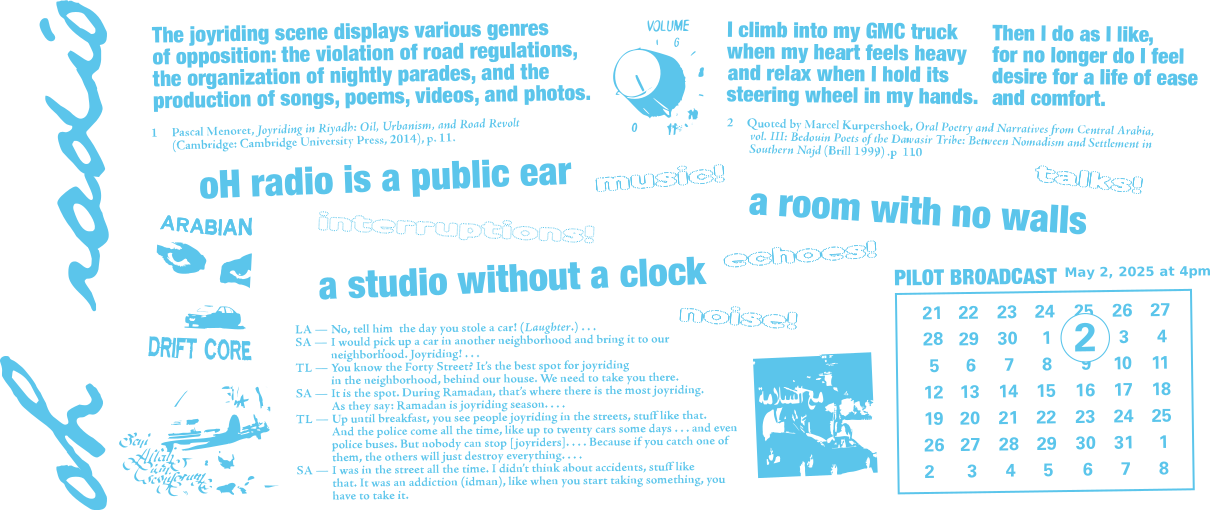
oH radio
is a public ear
is a room with no walls
is a studio without a clock
(from oh.eka-gd-ma.ee)
(Remix Reader)
.
WE WANT
roadside radio, puberty radio, silent radio, world radio, rotating radio, mobile-casting, non-participatory radio, participatory radio, entertaining radio, difficult radio, realistic radio, fictive radio, interstellar radio, erotic radio, perplexing radio, such-radio, body radio, desolate radio, absurd radio, hand-made radio, subcutaneous radio, automatic radio, sovereign radio, flexible radio, temporary radio, eternal radio, subversive radio, neuronal radio, thought radio, power radio, energy radio, digital radio, net radio, future radio, radio off!
(from Aufermann, Knut, Helen Hahmann, Sarah Washington, and Ralf Wendt, eds. 2019. Radio Revolten : 30 Days of Radio Art. First edition. Leipzig: Spector Books.)
The Radio as an Apparatus of Communication
[Excerpt]
In our Society one can invent and perfect discoveries that still have to conquer their market and justify their existence; in other words discoveries that have not been called for. Thus there was a moment when technology was advanced enough to produce the radio and society was not yet advanced enough to accept it. The radio was then in its first phase of being a substitute: a substitute for theater, opera, concerts, lectures, café music, local newspapers, and so forth. This was the patient’s period of halcyon youth. I am not sure if it is finished yet, but if so then this stripling who needed no certificate of competence to be born will have to start looking retrospectively for an object in life. just as a man will begin asking at a certain age, when his first innocence has been lost, what he is supposed to be doing in the world.
As for the radio’s object, I don’t think it can consist merely in prettifying public life. Not is radio in my view an adequate means of bringing back coziness to the home and making family life bearable again. But quite apart from the dubiousness of its functions, radio is one-sided when it should be two-.
It is purely an apparatus for distribution, for mere sharing out. So here is a positive suggestion: change this apparatus over from distribution to communication. The radio would be the finest possible communication apparatus in public life, a vast network of pipes. That is to say, it would be if it knew how to receive as well as to transmit, how to let the listener speak as well as hear, how to bring him into a relationship instead of isolating him. On this principle the radio should step out of the supply business and organize its listeners as suppliers. Any attempt by the radio to give a truly public character to Public occasions is a step in the right direction.
Whatever the radio sets out to do it must strive to combat that lack of consequences which makes such asses of almost all our public institutions. We have a literature without consequences, which not only itself sets out to lead nowhere, but does all it can to neutralize its readers by depicting each object and situation stripped of the consequences to which they lead. We have educational establishments without consequences, working frantically to hand on an education that leads nowhere and has come from nothing.
The slightest advance in this direction is bound to succeed far more spectacularly than any performance of a culinary kind. As for the technique that needs to be developed for all such operations, it must follow the prime objective of turning the audience not only into pupils but into teachers. It is the radio’s formal task to give these educational operations an interesting turn, i.e. to ensure that these interests interest people. Such an attempt by the radio to put its instruction into an artistic form would link up with the efforts of modern artists to give art an instructive character. As an example or model of the exercises possible along these lines let me repeat the explanation of “Der Flug der Lindberghs” that I gave at the Baden-Baden music festival of 1929.
“In obedience to the principle that the State shall be rich and man shall be poor, that the State shall be obliged to have many possibilities and man shall be allowed to have few possibilities, where music is concerned the State shall furnish whatever needs special apparatus and special abilities; the individual, however, shall furnish an exercise. Free-roaming feelings aroused by music, special thoughts such as may be entertained when listening to music, physical exhaustion such as easily arises just from listening to music, are all distractions from music. To avoid these distractions the individual shares in the music, thus obeying the principle that doing is better than feeling, by following the music with his eyes as printed, and contributing the parts and places reserved for him by singing them for himself or in conjunction with others (school class).”
“Der Flug der Lindberghs” is not intended to be of use to the present day radio but to alter it. The increasing concentration of mechanical means and the increasingly specialized training – tendencies that should be accelerated – call for a kind of resistance by the listener, and for his mobilization and redrafting as a producer.
This exercise is an aid to discipline, which is the basis of freedom. The individual will reach spontaneously for a means to pleasure, but not for an object of instruction that offers him neither profit nor social advantages. Such exercises only serve the individual in so far as they serve the State, and they only serve a State that wishes to serve all men equally. Thus «Der Flug der Lindberghs» has no aesthetic and no revolutionary value independently of its application, and only the State can organize this. Its proper application, however, makes it so «revolutionary» that the present-day State has no interest in sponsoring such exercises.
This is an innovation, a suggestion that seems utopian and that I myself admit to be utopian. When I say that the radio or the theatre “could” do so-and-so, I am aware that these vast institutions cannot do all they “could”, and not even all they want.
But it is not at all our job to renovate ideological institutions on the basis of the existing social order by means of innovations. Instead our innovations must force them to surrender that basis. So: For innovations, against renovation!
From Brecht on Theatre. Translated and edited by Jon Willett. New York: Hill and Wang, 1964. [«Der Rundfunk als Kommunikationsapparat» in Blätter des Hessischen Landestheaters, Darmstadt, No. 16, July 1932]
(via http://www.medienkunstnetz.de/source-text/8/)
TOWARD A DEFINITION OF RADIO ART
1. Radio art is the use of radio as a medium for art
2. Radio happens in the place it is heard and not in the production studio.
3. Sound quality is secondary to conceptual originality.
4. Radio is almost always heard combined with other sounds - domestic, traffic, tv, phone calls, playing children etc.
5. Radio art is not sound art - nor is it music. Radio art is radio.
6. Sound art and music are not radio art just because they are broadcast on the radio.
7. Radio space is all the places where radio is heard.
8. Radio art is composed of sound objects experienced in radio space.
9. The radio of every listener determines the sound quality of a radio work.
10. Each listener hears their own final version of a work for radio combined with the ambient sound of their own space.
11. The radio artist knows that there is no way to control the experience of a radio work.
12. Radio art is not a combination of radio and art. Radio art is radio by artists.
(via http://www.kunstradio.at/TEXTS/manifesto.html)
A Micro Radio Manifesto
Micro radio used to be a compromise to restrain oneself from using higher power transmitter because of the financial or regulatory reason. The first conscious micro radio started in the mid-1970s in Italy. As Félix Guattari wrote, "des millions et des millions d'Alice en puissance", over a thousand of micro free radio stations appeared along with the ‘Autonomia’ movement in Italy and then influenced other countries especially France. In Australia, the situation was different. Under the clever decision of Whitlam government, many cities started to have a new type of multi-lingual and multi-cultural community radio stations in the late 70s. In Japan, "Mini FM" boom began in the early 80s. It was a totally different type of micro radio: radio with literally micro-powered transmitter. It was a miracle that such a micro radio did work as a radio. So, the micro radio scene of the 80s was a mixture of the Italian free radio and a new element of the technological paradox.
After the late 80s, micro "pirate" stations in the US went into a new legal struggle against the authority for popular demands: Napoleon Williams' Black Liberation Radio in Illinois and then Stephen Dunifer’s Free Radio Berkeley were famous. In 2000, FCC started a new license category "LPFM" (Low power FM). This means that the micro radio in the US is institutionalized and also that those who transmit without license are considered as illegal. The early dream of micro radio paradise is over. Even such a micro enclave is now controlled by the system. It would be no surprise because nowadays every control invades into not only individuals but also their cerebral space. However, I still believe that micro radio can be located in different levels from the institutionalized space.
What do you intend to say by micro? In the core of the movements, "micro" of micro radio meant something beyond the mere size of transmitting power and service area. It connotes something qualitatively different. micro means diverse, multiple, and polymorphous. If micro does not mean small in physical size, then even physically bigger radio station could become micro. Micro radio is an alternative to mass medium and global communications that could cover the globe with the qualitatively same and patterned information. But even bigger medium is not always mass medium.
Today, our microscopic space is under technologically control and surveillance. Our potentially diverse, multiple and polymorphous space is almost homogenized into a mass. Therefore we need permanent effort to deconstruct this situation. In order to do this, to use a very low-power transmitter is worth trying. Small transmitter can be easily made by your own hands. But more than that. Theoretically you can do the same thing by high-power transmitter but it will deceive your perception what the micro is because you have been surrounded by numerous high-power transmissions of conventional radio. We have to use a kind of “phenomenological bracketting” to perceive what the things are.
LPFM covers up to 100 watts. "Community FM" in Japan (which was legally introduced as an institutionalized "Mini FM") allows 10 watts now (initially up to 1 watt). I think even these power levels are too much for micro radio. What about one watt? What about below one watt? Such a micro-power radio station could cover only a street block radius or only a housing complex. Why not? Leon Theremin showed the minimum example of micro radio. His invention is not only a musical instrument but also a micro radio.
Given the age of various global means such as the satellite communications and the Internet, micro radio can concentrate itself into its more authentic territory: microscopic airwave space.
Why don’t you go to a radio station just as you did to theatres. Micro radio theatre could be possible. The airwaves cover only a housing space. That is enough. I have been organizing micro radio party. This is an attempt to change a space to a qualitatively different by a micro transmitter.
Let’s start with your own familiar space. Change in a tiny space could resonate to larger space but without microscopic change no radical change would be possible.
Alternative medium tends to establish its own physical “home base.” But, as Hakim Bey argues, the today’s alternative “home base” is relevant only as “Temporary Autonomous Zone (T.A.Z.).” There is an another way: a method of “in exile”. After WBAI was controlled by commercial money, some of the programs such as “Democracy Now” started their program with a net.radio and a micro radio. “Democracy Now” rented a space in Lower East Side of New York and their program was broadcast as "WBAI in Exile". I think that in a sense radical radio is always did a good job in a certain sort of "exile": Radio Veritas, Manila in the 80s and B92 in the 90s. Internet is basically translocal medium. Different from printing medium, the space exits temporally and is out of geographical-physical location. Who cares where you are transmitting. You can maintain a “permanent” space with your listeners as long as you and your listeners agree with communicating. When I met Amy Goodman of "Democracy Now" and asked if their style using “low-tech” (their facilities and studio space) might derive from the micro radio culture, she denied my question as if I had not enough appreciated their activity. Of course it was not what I meant. Although WBAI is coming back to an authentic radical radio station again, the “in exile” form of collaboration (where independent micro units in exile can link together) is much more newer and viable. Given various “global” technology of linkage and relay, micro radio is enough in size for the unit of radio station.
As a means to cover larger area, airwaves are wasteful and not ecological. Big radio is no more necessary. Sooner or later, large and global communication technologies will be integrated into the Internet. Radio, television and telephone will become local nodes to it. Thus globalists will discard such exiting medium. A new type of multi-media terminal linking to the internet will appear. So it is the time when radio and television (and even telephone) must re-find their own emancipating possibility. Micro radio station will re-find a possibility of getting-together space such as theatre and club. It will not reject global medium but will use them as a linking and networking means. By translocal micro medium, even global medium could become polymorphous and diverse (not only in the contents but also in the style to let people encounter).
Tetsuo Kogawa (November 24, 2002/May 7, 2003/May 22, 2006)
(via https://anarchy.translocal.jp/radio/micro/index.html)
Forty-Six Thoughts on Radio
The beauty of radio is its off-switch. No matter what comes across the airwaves—no matter how annoying, absurd, or incongruous—you can always turn it off. The off-switch is a tool of empowerment for both broadcaster and listener. It allows the broadcaster to take chances; it allows the listener to opt-out.
Sitting alone in a studio broadcasting to 10,000 people, one must maintain the illusion that no one is listening.
You can never know exactly to whom you’re broadcasting, so it is useless trying to pander to an audience. At the same moment, one listener may be manacled at work while another may be manacled to a bedpost.
There are certain ruts and habits a DJ gets into. Automatic segues. One tends to repeat these again and again. The secret: the audience never notices.
Radio is background, not foreground. You are always doing something while listening—with one ear— to the radio. Nobody sits by the radio and just listens—with the exception of people driving. Along with artists, drivers are the best listeners. Artists’ hands and eyes are busy, but their ears are wide open. As a result, visual artists know more about music than anyone else on the planet.
When I first began broadcasting, I tried to make perfect segues from other people’s music. When I became good at that, presenting other people’s music became tedious. So I began to sing on the radio. I have a lousy voice. I would sing in front of generic karaoke tracks, enhancing my voice with the studio tools. Soon, I began putting on long instrumental tracks like John Coltrane’s “My Favorite Things” and singing Roland Barthes’ texts on top of them. I would do this sometimes for three hours at a time. Of course, it drove the listeners crazy.
Bertolt Brecht said, “I wish that they would graft an additional device onto the radio—one that would make it possible to record and archive for all time, everything that can be communicated by radio. Later generations would then have the chance of seeing with amazement how an entire population—by making it possible to say what they had to say to the whole world—simultaneously made it possible for the whole world to see that they had absolutely nothing to say.”
When I first got on the air at WFMU, the hippest radio station in the world, I took the on-air name, Kenny G, which is, in fact, my real name. It drove the listeners crazy at first, but over time, I became their Kenny G as opposed to the sax player.
When I first arrived at the station in 1995, I set up a primitive homepage that said “Welcome to Kenny G’s homepage” with a link to email me. It being the early days of the web, many people thought that they had found the “real” Kenny G’s secret homepage, made even more convincing by the fact that it was hosted by a radio station. I soon began getting fan mail intended for the sax-playing Kenny G, lots of it. I never wrote the fans back, fearing that word would get out that I was not him, and then the emails would stop. Each week, I would take the strangest, most obsessive letters and read them aloud on my show as if they were addressed to me. My bed music was always the Kenny G Christmas record.
One evening in an Italian restaurant in Chelsea, I got up to go to the bathroom. On the way, I overheard two traditionally dressed gentlemen mention the name “Kenny G.” Tispy as I was, I marched right up to the table and said, “Did I hear you say the name Kenny G? Well, I’m Kenny G!” They looked at me askance. I repeated my statement: “I’m Kenny G.” One of the gentlemen said, “Nice to meet you, but I’m Kenny G’s agent.” And it was true. This guy was the other Kenny G’s agent. I told him about my radio show and asked if it was possible for Kenny G to be on the Kenny G show. He smiled, said “Of course!” and I gave him my business card. We shook hands and he said he’d call me. I never heard from him again.
In 2003, I was on the radio Thursday evenings from 8-11pm. It just so happened that just as I went on the air on Thursday, March 20, 2003, the deadline for Saddam Hussein to leave Iraq had passed. For the next two hours, the country—and the world—was on edge, knowing that we were on the brink of war. It was just a matter of time until the invasion was to begin. I knew I couldn’t do a normal show, so instead, from 8 pm on, I only played eerie recordings of shortwave numbers stations, mostly created during the cold war, which were numbers repeated amidst bursts of feedback, static, and odd electronic sounds. At 10 pm, we invaded Iraq. I continued to play these numbers stations, but had my computer read out, in computer voice, short announcements like “The invasion has begun” and “We will destroy the enemy.” I never spoke—and so it went on for three hours, a creepy hazy ambience, which I thought was the only way to mark such an event.
The World Trade Center attacks happened right across the river from the WFMU studio. They occurred on a Tuesday, I went on the air that Thursday. During my shift, I played Allen Ginsberg’s “Kaddish” in its entirety and Gorecki’s “Symphony No. 3: Sorrowful Songs.” I didn’t speak on the show.
I was on the air on the morning after Obama was elected, from 9 am to noon. I played Parliament’s 1976 five-minute long “Chocolate City” over and over again for an entire three hours without interruption.
Each week, I had three hours to kill. That’s the way I saw it. How to fill up three hours?
In 2007, J.K. Rowling released the seventh and final Harry Potter and the Deathly Hallows. Prior to the book’s release the day I went on the air, someone had leaked a copy to the internet, enraging Scholastic Books, who threatened anybody distributing it with a heavy lawsuit. I printed out and sang in my horrible voice the very last chapter of the book on the air, thereby spoiling the finale of the series for anyone listening. During my show, the station received an angry call from Scholastic Books. It appears that their whole office was listening to WFMU that afternoon. Nothing ever came of it.
In the mid-90s, it was made illegal to distribute the DECSS code that was used to crack DVDs for replication. With this in mind, I read the entire code over the air and played songs that used the code as lyrics. I faked my arrest on air, leaving my shift a half-hour early, the air dead, the studio empty.
When I began doing radio, I was told by the station manager that my on-air voice was too smooth, too professional sounding. He suggested that I add some “ums” and “uhs” during my mic breaks to sound more like an average person.
On the air, not having anything to say, I began reading blogs that had nothing to do with me. For one show I’d read from blogs written by obese people trying desperately to lose weight. For another, I’d read from anorexic blogs written by skeletal people trying to gain weight. The following week, I’d read from depressive people trying to get happy. Because radio
is not a visual medium, people had no idea what I really looked like. And because I read so convincingly so as to sound like I was talking naturally, listeners thought I was, one week, wildly overweight or terribly emaciated. They had no idea that I was an average man, of average size and average weight.
Radio is best heard, not seen. Whenever you see an image of your favorite radio personality, you are inevitably disappointed.
One week, Gregory Whitehead came on my show and we had people call in and scream as loudly as they could for three hours.
My show was technologically determined. There was a time when, in the finder window, you could play several MP3s simultaneously, each with their own volume control and each able to be fast-forwarded and reversed. In essence, the computer’s finder became a mixer. But then Apple changed their OS and deleted that feature. When that happened, I was no longer able to do my show the way I used to.It lead to the end of my involvement in radio.
With Vicki Bennett, we did a show for three hours where we were bound and gagged to each other. We kept the mics on the entire time. Each half-hour, one rope was cut. The show started out silent. By the end, it was full on noise.
For three hours, I whispered the entirety of Karl Marx’s Communist Manifesto whilst dressed in an expensive suit.
For three hours, I played a tape of two men sleeping. The silence was punctured by snores.
For three hours I played the sounds of farts.
It is said that a baby’s cry is the most attention-getting sound in the human catalog of sounds. I once looped a piercing baby’s cry for an hour.
At first, listeners would call and complain. But after a decade or so, the complaints stopped. Those who didn’t wish to listen, left. The rest learned to either listen or else tolerate my weekly intrusion.
My show started off being called “Unpopular Music,” so you knew what you were getting into beforehand. If there were complaints, I would say, you were warned.
My idea was to get the listener to turn the radio off.
When you challenge someone not to listen, they listen harder.
My initial inspiration: the Mothers of Invention’s Absolutely Free, a collage which fused pop, noise, sound poetry, and classical music.
For a short time, the FCC allowed us to say swear words on air.
I seem to recall that you could say them ten minutes apart and that you were allowed to use them in a political way (“The government is fucked”) but not in a sexual way (“I want to fuck Laura Bush”). This lasted for a month or two and was then predictably rescinded.
My own work was informed by my years in radio. I learned how to speak publicly and consciously. I learned how to lie convincingly. I learned how the pitch and timbre of the voice can juice a situation.
For weeks, I would play the sources for my books on the air. For instance, for three weeks straight, I broadcast nothing but 1010 WINS traffic reports, which came to be my book Traffic. Then for the three weeks following that, I would read my transcripts of those traffic reports live on the air. That killed six weeks, 18 hours.
I did the same for weather reports and baseball games.
I had the idea to bring a radio into the studio and simply rebroadcast another station for three hours. I would just pull the mic down to the radio and walk away. I was told that this was highly illegal.
As long as you didn’t violate FCC codes, you could do anything you like for three hours. I always wondered why DJs would bother to play it safe when they were given all the freedom in the world. Why would they bother to pander to an audience, to be loved? (We weren’t paid, so it couldn’t have been about money or ratings.)
“Every once in a while,” said station manager Ken Freedman when fending off listener complaints about my show, “you’re just going to have to turn your radio off.”
Oftentimes I would back announce song titles for songs I didn’t play. Other times, I would back announce song titles from another DJ’s sets and shows for the entire three hours. Nobody seemed to notice.
I would transcribe my fellow DJ’s mic breaks and then read them as my own during my show. Nobody seemed to notice.
During a fundraiser once, I played musical sets from a popular rock ‘n’ roll DJ’s show and faithfully back announced them as my own. I didn’t raise any more money than I normally did.
In the end, each week on the air was three hours of performance art. I couldn’t keep that up forever.
I organized sets by keyword. Pick a topic, say, “dog,” and search an MP3 library containing hundreds of thousands of files for ID3 tags that had “dog” in it (which, naturally, had “god” in it). I’d come up with a beautiful freeform set, not based on how songs sound, but by what they’re about. The more MP3s on one’s hard drive, the more possibilities there are. Oftentimes, I never heard the song I was to play in the set, but because it had a keyword I was looking for, it conceptually worked.
iTunes allows you to sort songs according to their length. One week, I programmed three hours of audio that was all under thirty seconds long. The next week, I repeated the concept, this time with songs lasting exactly one minute.
When I ran out of ideas for a new show, I would just play one of my old shows in the public MP3 archive. Nobody ever knew the difference.
It was a delight to do back-to-back shows with Irwin Chusid—for years people have said that we are the same person because our voices are almost identical. Many weeks, we switched and pretended we were the other DJ. The listenership couldn’t tell the difference.
Why, in this age when everybody can download all the MP3s they want from the web, do we still listen to radio? Because we need someone to make sense of it all, someone with a sensibility to put it together for us, someone to narrate this mass of information.
by Kenneth Goldsmith
(via http://thirdrailquarterly.org/kenneth-goldsmith-forty-six-thoughts-on-radio/)
2000 YEARS OF CONVEX TV
Compiled for Convex TV by Martin Conrads
The mainstream is lagging in the exploitation of new media, but Convex TV, an on-line artist/funk magazine, organized amazing computer-enhanced chill-out zones and technological installations (2).
On Saturday, May 17th 1980, the day before they were to fly to America to begin their first US tour, Joy Division singer Ian Curtis visited his home in Macclesfield and watched the televised film Stroszek by his favorite director Werner Herzog. In America, Herzog shifts gears to a surreal road movie, ending with poor Bruno (sans Eva) adrift on a lonely ski slope, contrasted with Pavlovian dancing chickens (3).
In the 20th century, when people were still bathing in the aura of progress, a bunch of Berlin-based semi-youngsters decided it was time to dive into the processes of the aural. Heavily devoted to their tongues, ears and fingertips, they invented the idea of "convex tv." and started a three year journey, which took them to the edges of netspace, air-time and e-commerce (4).
The people from Convex TV had a radio show on the student university radio that had been given some of good old 'Voice of America's' airtime. The program was highly experimental, and used the internet during its broadcasts once a month for producing live texts and images. There was no sound here yet, on the internet that was. Listeners of the program through the ether, could take a seat in front of their computer and join in the live text event on their screens. People outside of the transmitter radius could do this also, having a very different radio experience indeed (5).
At the test bed of their futurity, convex tv. connected both radio and the net to the urban spaces of Berlin. By passing regular radio transmissions onto a multiplexity of broadcasting-levels, they left traces on the internet and on site for media-archeologists to discover. Demanding attention from more traditional media, they designed manifestos such as "HTML deejaying y/our favorite lo-tekst myth.", "there's a bandwidth playing on the radio", "*developed arrestment* - make alias. (a PJ for ten or six notes on the death of self-organisation)", "the porn empire links back", "some thoughts on the paste-media era", or "We Can't Stop the Dancing Chicken" (6).
We started with convex tv. in Berlin in late 1996. Our website had constantly evolved since early 1997. From the beginning we tried to develop the web content in accordance with our broadcasting issues, which for the most part were journalistic topics- digital culture, media culture, or electronic culture, as we preferred to call it. First, we put on our website all the transcribed programs we broadcast, so you could read it like an online magazine.
But very soon we saw that this was not the only possibility to work with online broadcast, with online presence. So even before we worked with the real audio software as a broadcasting tool, we developed a very low-fi broadcasting technology which we called "html-djing". It functioned like this (7):
Durante i primi periodi il collettivo non aveva gli strumenti adatti, la conoscenza e le connessioni per trasmettere segnali audio in rete. Fu allora che il collettivo pensò a una forma di trasmissione in rete parallela a quella via etere, per decostruire i confini dei media ordinari. L'invenzione era semplice: l'HTML deejaying. Mentre trasmettevano via etere (coprendo solo l'area di Berlino) trascrivevano testi die programmi e li cutuppavano spedendoli ad un server FTP, sincronizzato in tempo reale con la trasmissione in diretta. L'HTML DJ ricaricava la pagina con i nuovi contenuti quando bisognava farlo. Gli ascoltatori che avevano accesso solamente alla radio ascoltavano il ricevitore, quelli che avevano anche una connessione ascoltavano e leggevano, e gli ascoltatori che non potevano ascoltare, perché magari stavano a Budapest, avevano una strana esperienza di sola lettura. La pagina veniva continuamente aggiornata con nuove informazioni. Forse era la prima trasmissione testuale in rete che si comportava come un medium audio-visuale, forse era l'ultima. Ovviamente la trascrizione simultanea del parlato era una cosa improponibile: la versione testuale non era mai la versione più recente. Per cui c'erano errori, mancanze, piccole dissonanze tra il suono della radio e le immagini e i testi in rete. Per trasformare tutto ciò bisognava farlo in pubblico. -Streaming Texts- (8)
Then, during 97, very soon the real audio software became common as a streaming tool, so we started streaming on the web parallel to our on air programs, which normally were being produced once a month. Also we started to put up an archive of our streams and programs. We soon saw that this was one of the big advantages of net.radio in correspondence to traditional air frequency radio: You could get a feedback for things which were produced some time ago and also you could get e-mails by people who did research in the archive and then could reply to them. By having an archive you also offered an invisible audio sphere where the linear model of traditional on air frequency radio was broken up by the structures of the web - you produced an audio hyper structure, where it was up to the user to choose the files and create her or his own audio listening structure (9).
As everybody knew, there was no such thing as net.radio, but a great variety of ideas and experiments around *sound* on the internet. as all of you had your own unique experiences with "net.radio", we didn't want to provide a 24 hour schedule in a centralist planning style. instead we liked to ask all of you to participate in creating the contents of the meeting. to make it a little bit easier we had tried to define a matrix for topics, that could be discussed and/or be subjects of direct action and experiment (10):
As you could see from our homepage, we had a tripartite logo: This was due to our media strategy, which consisted of three levels of work: on air presence, on site presence and on line presence. The on site part was called "test bed", it was a semi-public space in Berlin, which we mostly used as an office, but sometimes also as a bar or an exhibition space. Also we invited DJs to come to our place to do live streams. It was never really figured out if something was more a work situation, a public party or an art situation (11).
Unfortunately, the first impression upon entering was that someone had broken in and made off with half the stuff -- indeed, some works were to be found at various other locations in the city. The model for the show was perhaps the Hybrid Workspace, a kind of information depot at Documenta X. Viewers were presented with some photocopies, a couple of televisions and a group of uninviting shelves housing a few tapes. Perhaps more interesting things could be found via the internet, at www.art-bag.org/convextv (12).
With an excellent techno-minimalist design --within what we could have called a 'clear line' style that was very easy on the eyes-- convex tv was one of the pioneering spaces that broadcast streaming images and sound in real time on the Internet (13).
One of the basic ideas of convex tv. was to make a link back from the very abstract use of radio as it was perceived then - as a mass medium - back to a really small community, to produce a kind of a community radio. I have to add that our archive was only made possible by the help of Radio Internationale Stadt and orang.orang.org, which is a Berlin-based audio server. I think that it was very hard always to react precisely and fast enough to what was constantly being developed by the media industry.
To (seemingly) cover this situation, we worked on a project called [.format], where we asked a lot of people to think about their use of formats, also to think about their use of the term "format". We made a website to present this project, here it was: http://www.art-bag.org/convextv/format. The basic idea was to use a globe as a symbol of [.format]. Within this project, we realized a series of interviews with people about the format-idea. We also asked artists to contribute to an audio CD, to do audio pieces about their ideas of formats. Also, we made a 24 hours program where we invited special people to come to test bed and contribute by producing programs on the format issue. In the end it showed that the most important format was the own body, because if you broadcast for 24 hours and you were always in the same room, then the room, and within that room your own body, became a format itself (14).
Convex.tv had an online archive of both audio files and text on their site, of which the text was unfortunately mostly in German, even if the interview it originates from was in English. To give you an impression of the activities here are some interview excerpts (15):
Q: what was convex tv.?
A: convex tv. was multi-dimensional:
a) an on-air radio program,
b) an internet audio archive/database (stored at Radio Internationale Stadt),
c) the convex tv. plug-in, the parallel broadcasting of audio and text files,
d) ad hoc installations in art spaces and last but not least
e) a virtu(re)al space for socializing. but:
f) it was not *club-art* whatsoever!
Q: and what was convex tv. in terms of *content*?
A: convex tv. was dealing with the cultural, political, economical aspects of digital technology, end-of-the-century pop culture and art. the main format of these contents were audio-files on the internet. (for more info on this subject > see below.) most of the spoken word carried by this audio data was German. but there were also some programs in English.
Q: who was convex tv.?
A: convex tv. was a collective of 3-14 persons coming from different backgrounds, permanently contracting and expanding...
Q: was convex tv. radio on the internet or internet in the radio?
A: with the combination of on-air radio and its RealAudio database convex tv. was all in one: convex tv. dealt with questions of digital technologies on its traditional radio show and brought radio into the net. with this model convex tv. combined two different kinds of accessibility. whereas on-air radio was able to reach a mass audience (at least in theory) at one moment in time, our archive was accessible whenever you wanted to - and you were a mass audience, too (16).
There were many examples of very different and yet similar approaches of this traditional webcasting, from Convex TV, which approached both radio and the internet in a conceptually radical art-way (17):
[Click here!]
..........Click Here!
------------------------------------------------------------------------
You were here: Home > Computing & Internet > Web Building > Studio > Feature Story
Feature Story
[spacer GIF][Click here!] [Click here!] [Click here!] [Image]
[Image][Image] [Image][Image][Image] [Image][Image][Image]
Departments ...........Audio in Action:
Design
Development ...........The Complex World of convex.tv
E-business
Careers & Training
Graphics & ..............decided to conduct a little behaviorist experiment.
Multimedia ..............The scene was Documenta X, 1997, one of Europe's most important
Sysadmin .............. .art events, staged only once every five years in Kassel, Germany.
.............................As part of the extravaganza,.the Hybrid WorkSpace had
Web Building ............been set up for various groups - including the net.radio
Studio .............. .. ..collective convex tv. - to come in and, well, work.
Computing & ...........The crowds who've poured into Kassel from all over wandered
Internet .............. ..through the exhibition and, eventually, into the Hybrid
Buy Software ..........WorkSpace, where they found a group of appropriately
Online ................ .. artsy-looking twenty-somethings sitting around a table talking,
Download .............. .passing papers back and forth, and smoking hand-rolled
Hardware ............. . cigarettes. A few others tapped a bit at computers before getting
Tech Resources .......up again and wandering off, and a guy with headphones was
Tech News ..............flipping records (Sun Ra then) on two turnstiles in
Web Site Services ....front of some industrial-age contraption with lots of impressive
Software Reviews .....knobs and switches.
Games
Support ............ .. ..The crowds were confused. They milled around, reading manifestos
.............. .. ............pinned to the whitewashed walls, glanced at the radio innards
.............. .. ............strewn out in front of a perplexed fellow with a set of pliers,
.............. .. ............and milled around some more.
.............. .. ............Was this art? It didn't really even look that much like work (18).
There was a historical gap between the two formats of text and sound, it seemed. but there was a tiny moment in history, when the gap was bridged by a unique technique (19): Dancing stored information, retrieving radio at loose ends.
Before hooking up with the gravy train that was Elvis, the Colonel made a living working in carnivals and fairs, and was founder of the Great Parker Pony Circus and Colonel Tom Parker and His Dancing Chickens. For the latter, he would place live chickens on a hot plate covered with sawdust; the chickens then shook their legs and hopped about to avoid the heat.
Dance, dance, dance, dance, dance to the radio.
Dance, dance, dance, dance, dance to the radio.
Dance, dance, dance, dance, dance to the radio.
Dance, dance, dance, dance, dance to the radio. (20)
"trimm dich" - the motto of the gathering - had been borrowed from a west german 1970s campaign for public health and meant: get fit! mikro and convex tv. provided beds and vitamin-breakfast, having helped you to achieve this aim...
In general Berlin net.radio-days didn't want to be a strictly organized symposium, but an open space for meeting and discussion. net.radio-days were organized by the Berlin based organisation of "mikro" in cooperation with the local convex tv. collective and took place at several locations in town (21).
Media collectives across Europe had spent the final years of the last century learning to transgress national borders via new modes of shared broadcasting and artistic creation. The Berlin-based - and recently deceased - collective convex tv. came to the conclusion (22): "there were a few simple reasons for doing things collectively: technologically and
economically speaking the collective was the only space where you could be marginally successful and successfully marginal. that meant: in order to create marginal media products you had to invest the same amount of energy and intelligence as into a mainstream product. that was the rule of the mutual." (23)
It was not even that we had to sell ourselves. There was a really good text of convex.tv's website actually called "Make Alias" about the desirability of marginal collective groups from many point of views. We all knew about this cultural capital stuff that was going on, and it got really difficult. But convex tv view was 'make an alias', which I really liked (24).
As everything got wireless, media of all kind were moving to the centralized matrix known as the Ether. While the traditional forms -internet, multimedia - showed many signs of vanishing, the Ether was being invaded by even older media species. convex tv. was one. Yet with each additional transmitting station, each new antenna, the media the Ether could support became richer, more complex, more differentiated. The Ether had begun offering things you simply couldn't hear (25):
In the manner of the tradition of Enlightenment Europe's academies of arts and sciences, convex tv., in co-operation with you, were soliciting responses from a global public and in sound form to the following Prize Contest. This announcement was addressed to all persons, anywhere in the world. You were invited to respond to our Prize Contest in a creative way and from whatever happened to be your own techno cultural perspective and background. You should have aimed to provide the most convincing and conclusive solution possible in a spirit of open competition. On the threshold of a new millennium, this international competition of minds hoped to become a symbol of a creative and co-operative global society in the 21st century.
The Prize Question:
Producing an Advurt (jingle) to promote the general or specific ideas, conditions, utopias, references of net.radio to a worldwide audience!
The Advurts had to address the following issue:
Liberating the net from radio?
Liberating radio from the net?
The Prize: 1 net.radio (26)
Part of our agenda was, never to precisely define what we were doing, which also was an effect of convex tv. being 14 people with different occupations. With convex tv. it was a very mixed level of working and communicating with each other, and these situations then "produced" convex tv., a constant working with images and sounds, space, text and people. This, I think, was the most important part of the project: having a room, where people could come and talk with each other. Also we always produced misunderstandings "for example the whole website was not designed that well…
(27)
Thus, people could follow the adventures of this small collective on their journey to friendship, fame and happiness. But this was only the theory-module of the whole story. Just think of their practice and you wish the millennium had never come: the connection of media, the construction of situations, the simulation of institutions, the intuition of inversion, the invention of objects, the subject of formatting. All of these and many more were the nouns to sentences which contained verbal forms such as "streaming", "hosting", "presenting", "inviting", "joining", "listening", "defining" and "speaking". Having tested every single word, sound, space, time, situation, bit, tag and .net which was available at that time, our travelers were finally mesmerized by their own significance, and transformed themselves into a project of the past by deprocessing every vehicle used, except their friendship (28).
Colonel Tom Parker, Elvis Presley's longtime manager, died Tuesday of complications from a stroke. He was eighty-seven.(29)
There was a bandwidth playing on the radio (30).
List of hyperlinks:
1. http://www.art-bag.org/2000years
2. http://www.artnet.com/magazine_pre2000/reviews/goldman/goldman2-6-98.asp
3. http://www.art-bag.org/convextv/pro/chicken.htm
4. http://web.archive.org/web/20010909180822/mi.cz/obl/online/convex.htm
5. http://www.heise.de/tp/english/special/ku/6169/2.html
6. http://web.archive.org/web/20010909180822/mi.cz/obl/online/convex.htm
7. http://web.archive.org/web/20030408191513/http://www.i-lab.org/b6cor.htm
8. http://www.rekombinant.org/media-activism/article.php?sid=32
9. http://web.archive.org/web/20030408191513/http://www.i-lab.org/b6cor.htm
10. http://radioqualia.va.com.au/ctl/texts/convex.html
11. http://web.archive.org/web/20030408191513/http://www.i-lab.org/b6cor.htm
12. http://www.artnet.com/magazine_pre2000/features/allen/allen11-22-98.asp
13. http://aleph-arts.org/epm/eng/webs.html
14. http://web.archive.org/web/20030408191513/http://www.i-lab.org/b6cor.htm
15. http://www.kunstradio.at/FUTURE/RTF/SYMPOSIUM/LECTURES/BOSMA/bosma-txt.html
16. http://www.yourserver.co.uk/revolting/workplace/convextv/ (missing)
17. http://homestudio.thing.net/revue/content/bosma.htm
18. http://home.netscape.com/computing/webbuilding/studio/feature1999v1n2-2.html
19. http://amsterdam.nettime.org/Lists-Archives/nettime-l-9902/msg00089.html
20. http://www.art-bag.org/convextv/pro/chicken.htm
21. http://radioqualia.va.com.au/ctl/texts/convex.html
22. http://www.unesco.org/courier/2000_07/uk/doss33.htm
23. http://www.art-bag.org/convextv/pro/alias.htm
24. http://www.irational.org/irational/media/berry2.txt
25. http://amsterdam.nettime.org/Lists-Archives/nettime-l-9902/msg00089.html
26. http://www.art-bag.org/convextv/pro/station/2/station/index1.html
27. http://web.archive.org/web/20030408191513/http://www.i-lab.org/b6cor.htm
28. http://web.archive.org/web/20010909180822/mi.cz/obl/online/convex.htm
29. http://www.art-bag.org/convextv/pro/chicken.htm
30. http://www.art-bag.org/convextv
This text was originally compiled for the net.congestion-reader in 2000 (and later posted to nettime). It consists only of fragments of texts about or from "convex tv." that can be found online. Since "convex tv." dissolved in December 1999, for this text all phrases were put in the past tense. From the original hyperlinks of 2000, only one was missing in 2004, all the others still remain intact or could be updated. (mc)
(via http://subsol.c3.hu/subsol_2/contributors3/conradstext.html)
Rough for Radio I
Written in French in late 1961. First published in English as ‘Sketch for Radio Play’ in Stereo Headphones, no. 7 (Spring 1976).
HE: [Gloomily.] Madam.
SHE: Are you all right? [Pause.] You asked me to come.
HE: I ask no one to come here.
SHE: You suffered me to come.
HE: I meet my debts.
[Pause.]
SHE: I have come to listen.
HE: When you please.
[Pause.]
SHE: May I squat on this hassock? [Pause.] Thank you. [Pause.] May we have a little heat?
HE: No, madam.
[Pause.]
SHE: Is it true the music goes on all the time?
HE: Yes.
SHE: Without cease?
HE: Without cease.
SHE: It’s unthinkable! [Pause.] And the words too? All the time too?
HE: All the time.
SHE: Without cease?
HE: Yes.
SHE: It’s unimaginable. [Pause.] So you are here all the time?
HE: Without cease.
[Pause.]
SHE: How troubled you look! [Pause.] May one see them?
HE: No, madam.
SHE: I may not go and see them?
HE: No, madam.
[Pause.]
SHE: May we have a little light?
HE: No, madam.
[Pause.]
SHE: How cold you are! [Pause.] Are these the two knobs?
HE: Yes.
SHE: Just push? [Pause.] Is it live? [Pause.] I ask you is it live.
HE: No, you must twist. [Pause.] To the right.
[Click.]
MUSIC: [Faint.]
[Silence.]
SHE: [Astonished.] But there are more than one!
HE: Yes.
SHE: How many?
[Pause.]
HE: To the right, madam, to the right.
[Click.]
VOICE: [Faint.]
SHE: [With voice.] Louder!
VOICE: [No louder.]
[Silence.]
SHE: [Astonished.] But he is alone!
HE: Yes.
SHE: All alone?
HE: When one is alone one is all alone.
[Pause.]
SHE: What is it like together?
[Pause.]
HE: To the right, madam.
[Click.]
MUSIC: [Faint, brief.]
[Silence.]
SHE: They are not together?
HE: No.
SHE: They cannot see each other?
HE: No.
SHE: Hear each other?
HE: No.
SHE: It’s inconceivable!
[Pause.]
HE: To the right, madam.
[Click.]
VOICE: [Faint.]
SHE: [With voice.] Louder!
VOICE: [No louder.]
[Silence.]
SHE: And– [Faint stress.]—you like that?
HE: It is a need.
SHE: A need? That a need?
HE: It has become a need. [Pause.] To the right, madam.
[Click.]
MUSIC: [Faint.]
SHE: [With music.] Louder!
MUSIC: [No louder.]
[Silence.]
SHE: That too? [Pause.] That a need too?
HE: It has become a need, madam.
SHE: Are they in the same … situation?
[Pause.]
HE: I don’t understand.
SHE: Are they … subject to the same … conditions?
HE: Yes, madam.
SHE: For instance? [Pause.] For instance?
HE: One cannot describe them, madam.
[Pause.]
SHE: Well, I’m obliged to you.
HE: Allow me, this way.
[Pause.]
SHE: [A little off.] Is that a Turkoman?
HE: [Ditto.] Allow me.
SHE: [A little further off.] How troubled you look! [Pause.] Well, I’ll leave you. [Pause.] To your needs.
HE: [Ditto.] Good-bye, madam. [Pause.] To the right, madam, that’s the garbage—[Faint stress.]—the house garbage. [Pause.] Good-bye, madam.
[Long pause. Sound of curtains violently drawn, first one, then the other, clatter of the heavy rings along the rods. Pause. Faint ping—as sometimes happens—of telephone receiver raised from cradle. Faint sound of dialling. Pause.]
Hello … Miss … is the doctor … ah … yes … he to call me … Macgillycuddy … Mac-gilly-cuddy … right … he’ll know … and Miss … Miss! … urgent … yes! … [Shrill.] … most urgent!
[Pause. Receiver put down with same faint ping. Pause. Click.]
MUSIC: [Faint.]
HE: [With music.] Good God!
MUSIC: [Faint.]
[Silence. Pause. Click.]
VOICE: [Faint.]
HE: [With voice, shrill.] Come on! Come on!
VOICE: [Faint.]
[Silence.]
HE: [Low.] What’ll I do? [Pause. Faint ping of receiver raised again. Faint dialling. Pause.] Hello … Miss … Macgillycuddy … Mac-gilly-cuddy … right … I’m sorry but … ah … yes … of course … can’t reach him … no idea … understand … right … immediately … the moment he gets back … what? … [Shrill.] … yes! … I told you so! … most urgent! … most urgent! … [Pause. Low.] Slut!
[Sound of receiver put down violently. Pause. Click.]
MUSIC: [Faint. Brief.]
[Silence. Click.]
VOICE: [Faint. Brief.]
HE: [With voice, shrill.] It’s crazy! Like one!
[Telephone rings. Receiver raised immediately, not more than a second’s ring.]
HE: [With music and voice.] Yes … wait … [Music and voice silent. Very agitated.] Yes … yes … no matter … what the trouble is? … they’re ending … ENDING … this morning … what? … no! … no question! … ENDING I tell you … nothing what? … to be done? … I know there’s nothing to be done… what?… no! … it’s me … ME … what? I tell you they’re ending … ENDING … I can’t stay like that after … who? … but she’s left me … ah for God’s sake … haven’t they all left me? … did you not know that? … all left me … sure? … of course I’m sure … what? … in an hour? … not before? … wait … [Low.] … there’s more … they’re together … TOGETHER … yes … I don’t know … like … [Hesitation.] … one … the breathing … I don’t know … [Vehement.] … no! … never! … meet? … how could they meet? … what? … what are all alike? … last what? … gasps? … wait … don’t go yet … wait! … [Pause. Sound of receiver put down violently. Low.] Swine!
[Pause. Click.]
MUSIC: [Failing.]
[Telephone rings. Receiver immediately raised.]
HE: [With music and voice.] Miss … what? … [Music and voice silent.] … a confinement? … [Long pause.] … two confinements? … [Long pause.] … one what? … what? … breech? … what? … [Long pause.] … tomorrow noon? …
[Long pause. Faint ping as receiver put gently down. Long pause. Click.]
MUSIC: [Brief, failing.]
[Silence. Long pause.]
HE: [Whisper.] Tomorrow … noon …
..
There is something rather magical about radio waves.
They’re actually some sort of invisible energy.
(from: The Secret Life of the Radio by Tim Hunkin – https://www.youtube.com/watch?v=LMxate9gegg)
(Broadcasting Guide)
Broadcasting
There currently are two options for publishing broadcasts / audio via oH radio.
The first one is to simply upload an audio file the intro card and the cover to the website via oh.eka-gd-ma.ee/uploader.php (you can find the log-in information on the oH radio archive drive in the library or by contacting barashedharon@gmail.com) and fill in an entry in the google sheet content management system – the link for that can be obtained the same way.
For this no specific software is needed! The audio lives on the oH radio webserver and can be played from there.
The second one is to webcast the audio live which to me always feels more exciting and often is also less of a hassle than recording and editing a bunch of audio.
Webcasting is broadcasting / streaming over the internet.
What is streaming? Streaming is sending whatever is happening on your computer/device to the world via a SERVER, in the case of oH radio the server from EKAGDMA-alumn Karthik. The server then then distributes your stream to listeners via a web link: In this case, oh.eka-gd-ma.ee
In the case you aren’t using Karthik’s server, you can also use a service, like radio.co., they run a good service for hosting your own radio with stats. (Hack: the Radio.co subscription is free for seven days and can be signed into with new email-addresses.)
To broadcast live a few things (hardware and software) are needed all of which are contained within the oH radio toolkit which are outlined and described in the following sections aptly named Hardware and Software.
Glossary
There is an ongoing discourse about gendered nomenclature in electronic components (for a general overview see https://en.wikipedia.org/wiki/Gender_of_connectors_and_fasteners).
In the following description the terms plug and socket are used instead of male and female. In many stores (online and physical) you very possibly will still encounter the old nomenclature.
This is somewhat good to know in regards to cables.
Mono stands for monophonic and means that one channel / 1 sound signal can be transported.
Stereo is short for stereophonic and means that two channels / 2 sound signals (usually left and right) can be transported.
It is quite important to keep an eye on the the sound levels.
An audio cable is usually made up of two or more connectors with a piece of cable between. There are a couple of different connectors in the world of audio which can be a bit confusing.
left: XLR plug / right: XLR socket
XLR cables are common in professional audio applications. They carry a balanced audio signal which is often better for sound quality. (read more) The AG06 Mixer has 2 sockets for XLR cables which can be used for instruments and microphones.
XLR cables are always mono.
left: two RCA plugs / right: two RCA sockets
It’s the classic red an white cable. The white connector usually is for the left stereo channel and the red connector for the right stereo channel.
left: 3,5mm Jack plug / right: 3,5mm Jack socket
The quintessential audio cable. But there are some twists! Depending on the amount of rings the connector has (image via) the cables can do different things all the way from carrying 1 channel / signal to doing 2 channels and a microphone input. Same goes for sockets although it is a bit harder to figure out.
left: 6,3mm Jack plug / right: 6,3mm Jack socket
It’s like the small AUX but with a bigger connector which is more sturdy and also quite a bit more common in “more professional” sound contexts. The oH radio Mixer also has a lot of 6,3mm plugs.
6,3mm Jack cables usually carry mono or stereo signals. It all depends on the rings again!
Hardware
The current oH radio set up consists of the following parts:
1 Yamaha AG06 Mixing Console
1 pair of Audio-Technica ATH-M20x Headphones
1 Audio-Technica AT2005USB Microphone with an XLR cable that does not come off
1 off-brand Walkman CD Player (Model: KC-918)
1 Zoom Field Recorder (Model unknown) - available from the teachers office
5 Stereo 3,5mm Jack (aka small / normal AUX) to 6,3mm Jack (aka big/large AUX) adapters (two of those connectors are screw-on so they don’t really work that well)
1 USB A plug to USB B plug cable (also known as printer cable) - This one is important to connect the mixer to a computer!
1 Audio-Technica Boomarm (This also lets you connect the microphone to your computer via USB. I have never tried it but it is most likely easy to figure out!)
...
The oH radio mixer is a Yamaha AG06 Mixing Console. It is the centerpiece of the broadcasting set up and can be connected to a computer via USB.
On a Mac no additional drivers are required on a Windows device they might be. The drivers can be found on https://yamahaproaudoi.com /ag/
The mixer’ manual contains all the necessary information on how to use it. The english paper version seems to have gone missing but can be accessed and downloaded via oh.eka-gd-ma.ee/Mixer-Manual.pdf
Some of the most important parts are reproduced in the following section:
1. Turn off the power of all speakers, instruments, and other devices to be connected to the mixer.
2. Connect speakers, microphones and instruments referring to the connection example below.
1. Make sure that all switches including the Standby/On switch are not pressed().
2. Use the included USB cable to connect your computer to the mixer.
When using the [USB 2.0] terminal on the mixer‘s rear panel, refer to the notice “Precautions when using the [USB 2.0] and [5V DC] terminals.”
When connecting a tablet or other device that cannot provide power to the mixer, connect a commercially available USB power adapter or USB mobile battery to the [5V DC] terminal (micro B).
3. Turn the [GAIN] knobs, Level knobs, Speakers knob, and Headphones
knob fully to the left (minimum).
4. Make sure that the volume of a powered speakers is set to minimum.
5. Turn on the power to connected devices in the following order: Instruments, audio devices > Mixer's On/Off switch > Powered monitor speakers.
(Follow this order to avoid loud, unexpected noise from the speakers. Reverse the order when turning the power off.)
6. For channels to which a microphone or instrument is connected, set the [GAIN] knob to the 12 o'clock position.
7. Set the Level knobs to the 3 o'clock position.
8. Set the Speakers knob and the Headphones knob to the 12 o'clock position.
9. Speak into your microphone, play your instrument, or play your audio device, and adjust the volume on the powered monitor speakers.
10. If no sound is heard, or if you want to adjust the volume, follow the instructions in the section below.
If you still do not hear the sound after doing the following steps, please refer to the checklist in the "Troubleshooting" section at the back of the actual Manual linked above.
1 Speak into your microphone or play your instrument, turning the [GAIN] knob to the right so that the corresponding [PEAK] LED flashes briefly.
(For optimum volume when using a microphone, place the microphone as close to the sound source as possible. If the [PEAK] LED does not light even if the [GAIN] knob has been turned fully to the right, raise the volume of the sound source (instrument, etc.).)
If no sound is heard or the volume does not increase after step 1:
2 If the [PAD] switch or [GAIN] switch is turned on (pressed down), turn the Level knob fully to the left to "0" (minimum), and then turn off (not pressed down) the switches.
3 Slowly turn the Level knob to the right until the desired volume is reached.
1 Turn the Level knob fully to the left to "0" (minimum), and then turn on (press down) the [PAD] switch or [GAIN] switch on the channel for which you want to decrease the volume.
2 Slowly turn the Level knob to the right until the desired volume is reached. If the volume does not decrease after the above steps:
3 Lower the volume of the instrument or audio device.
(A small illustration of how the sound moves through the device!)
Following these steps should result in a working set up with the mixer connected to your computer. The volume of the computer’s audio can be controlled by using the know above this:symbol.
In order to send the computer’s audio to the mixer it needs to be selected as the audio output where it usually show up as AG06/AG03(the screenshot shows the Mac OS sound control panel).
One great thing about the mixer for broadcasting is that it is kind of geared towards webcasting because it has a loopback function which takes the sounds from the different channels of the mixer (including the sound the computer send to it) and sends it back to the computer! There it can be selected as an audio source in BUTT.
In order to use oH radio’s microphone the mixer is needed. It can simply be plugged into Channel 1 or 2 which gives control over the Volume.
Note: The microphone has an on and off switch. If there is no sound it might just be turned off!
Note 2: The microphone also has its own volume control. Usually its simpler to keep all the volume controlling in one place.
Software
There are one to two pieces of software that are necessary for getting a broadcast live on air on oH radio. The most important one is:
It is a streaming software that allows you to connect to a server (more on this later) to stream live. It also has a recording function which is very handy for archiving purposes.
BUTT is best downloaded from the developers website: https://danielnoethen.de/butt/.
The site also has a comprehensive guide for setting it up!
After installing the program and launching it this very retro window should appear:
When opening BUTT for the first time it’s a good idea to just get the setting up part over with!
That can be done via pressing the Settings button.
In the settings it's a good first step to set up the recording functionality by navigating to the Record tab.
It’s really only necessary to set a Record Directory that makes sense and to check the box that says Start recording when connected. This avoids having to start recordings manually when starting a broadcast which avoids forgetting it and losing a beautiful live broadcast to the ether.
Next up is setting up the connection to the streaming server via the Main tab. (oH radio’s live broadcasts are currently (generously) hosted via EKAGDMA-alumn Karthik’s personal server. So it’s always a good idea to check in with him if it is still running!)
Clicking the ADD button will lead to this windowwhere all the relevant data can be filled in. The connecting-information is stored in a .txt file on the oH radio archive drive and alternatively can be found out by asking Karthik or Haron.
Before being ready to go on air there is one last step which is setting up the audio inputs that BUTT uses to send sound to the server and then to people. The audio settings can be accessed via Settings > Audio.
Streaming > Codec can be set to MP3
Streaming > Bitrate can be set to 128k (that saves data when streaming which is nice for people with bad connections)
The most important setting is Primary Audio Device which defines the audio that gets sent out into the world!
Depending on the audio devices available there are a lot of options here:
If the mixer is connected it should show up as AG06/AG03.
If the stream is coming only from a computer then the Audio-Routing channels should be selected – for example BlackHole 2ch.
Once that is set and there is some audio playing it should show up as a beautiful green bar in the main interface of BUTT:
To go live all that now needs to be done is to press the PLAY button!
Both of these are Virtual Mixers used for audio routing. They are programs that make it possible to send audio from one program (for example Ableton or Audacity or the software that handles the general sound output of a computer and can be accessed in the audio settings of any computer) to another – in our case to BUTT.
So these programs are used to to “plug” the sound coming out of your computer into another software. This allows you to route your sound to the streaming software (BUTT) where it can be streamed live and recorded.
Blackhole/Soundflowers are like a fake loop, it simulates a “interior mixer”, it turns the sound of your computer into an input that can be streamed.
Add BLACKHOLE 16ch / SOUNDFLOWER and use your own computer to stream different channels (for example if you want to play music and talk l at the same time).
FOR MAC:
Blackhole >> https://github.com/ExistentialAudio/BlackHole
How to use Blackhole: https://www.youtube.com/watch?v=9aGU1sr-_Tw
Soundflower >> https://soundflower.en.softonic.com/mac/download
FOR WINDOWS:
Virtual Audio Metter >> https://www.vb-audio.com/Voicemeeter/
How to use >> https://www.youtube.com/watch?v=EdAhR_CdjLc
Once they are set up they appear in the audio settings just like normal headphones or speakers and can be selected as outputs.
NOTE: When for example Blackhole 2ch is selected as an audio output on a computer no sound will come out of the speakers or any other connected devices anymore.
There are ways to circumvent this but they are a bit more complicated. This article: https://vninja.net/2020/02/04/macos-multi-output-devices/ gives a pretty good overview of this!
Setups
This section was taken from the radioee.net co-streaming manual (link) and slightly reworked.
“I ONLY HAVE A COMPUTER AND I WANT TO SPEAK THROUGH ITS MIC”
For broadcasting from a computer. No mixer / external microphone is needed. You can use the internal microphone of your computer.
a computer
BUTT
BUTT with the computer microphone selected as the input
“I ONLY HAVE A COMPUTER AND I WANT TO SPEAK THROUGH ITS MIC”
“...AND ALSO PLAY SOUND” OR
“...AND ALSO DJ WITH A CONTROLLER AND A SOFTWARE”
a computer
Virtual Mixer Software (BlackHole / Soundflower)
BUTT
Computer Audio > BlackHole > BUTT
This is the most common and handy. Using the oH radio mixer you can plug in different inputs (phones, mp3-players, CD-players, the computer itself) and send the sound out via your computer to stream. You can use headphones or monitors to listen in real time what is being sent.
Required Hardware
oH Radio Mixer
Microphone(s)
Computer
(a bunch more audio devices can theoretically be connected)
Required Software
BUTT
(if on windows then also a driver)
Setup
Microphone > Mixer Channel 1 via XLR cable
(Microphone 2 > Mixer Channel 2) via XLR cable
Mixer USB > Laptop / Computer
MONITOR OUT with headphone symbol > Headphones
MONITOR OUT with speaker symbol > Speakers (there needs to be one cable per speaker)
Inputs: Microphones, Ipad, DJ setup (vg. CDJs), instruments…
Interface: Radio Mixer / Soundcard
Outputs: Computer, headphones, speakers
(Slideshow)
PUB Sandberg
(PUB Broadcasting Mobile during the 2018 Sandberg Graduation Broadcasting Marathon, image via: https://pub.sandberg.nl/radio/graduation-marathon-2018)
Caption:
A three days nomadic live radio transmission visiting the graduation shows of the Sandberg Instituut. The mobile radio station traveled around Amsterdam, serving as a space for distribution and reflection. PUB Radio broadcasted conversations, readings, music, live feed reports, sound experiments and more from all Sandberg’s departments.
(from: https://pub.sandberg.nl/information:
PUB is an trans-departmental initiative funded and run by students of the Sandberg Institute. Establishing a publishing practice at the University, PUB functions as a hub and a platform to identify interdisciplinary connections and accelerate collaborations amongst students, alumni and third parties. PUB’s channels include radio, Tv, PUBcast, website, Type Lab, Journal, and publishing sessions.)
Network
(Network-website, image is a screenshot of the page)
Invited in 2015 by the BBC to participate in a 6-month residency, Jaar instead set out to write a radio play which positioned an invented DJ at the helm of his own residency inside a fake BBC-style radio world. The program was ultimately deemed too far out and never realized. In its place Jaar approached programmer Cole Brown to collaboratively devise http://other-people.network, a website which would host the programs on continuous loop inviting users to sift through the stations with a radio like dial - and later - a random number inputting system, 1-333.
The stations are made up of more than 20 hours of Jaar’s own mixes as well as original music, among them his recently released album Sirens – the remaining are constructed “fakes”, conceptual audio works created with the help of voice actors. Billionaire FM counts down and offers commentary on the annual Forbes list of world’s top billionaires one by one. MATTA CLARK DEMOLITIONS is comprised of “noises” gathered from the structures which artist Gordon Matta Clark transformed into architectural cut-ups. Red Bull Sponsored Revolutions plays Mozart 24/7.
Phantom Radio
(PHANTOM RADIO’s hidden studio, image via https://019-ghent.org/phantom-radio/)
PHANTOM RADIO is an ongoing project, a 91.0 MHz FM radio station (g)hosted by Ine Meganck and Valentijn Goethals. The project was originally initiated in collaboration with Paul Elliman (UK) at the Werkplaats Typografie, a former radio distribution center. For those working late into the night at our computers, the space still crackled with the ghostly static of residual electronic energy. Within this project a space was created, to re-locate the lost origin of the building. Hidden in a secret room above the kitchen, an acoustic window on a world alive with electronically activity awaited to be opened.
The Phantom Radio became an unconventional space for students, designers, musicians and artists. A place where participants for a short period of time could trade the medium of printed matter and parasite the airwaves. Keeping in mind a series of limitations.
Nowadays the Phantom Radio functions as a nomadic radio station. The project isn’t tied to one specific location nor time-zone. 019 functions as an important transmission territory for the Phantom Radio. Already using this platform for our first exhibition in March 2014.
Tetsuo Kogawa
(Live at St John's Church, Island Road, Barrow-in-Furness, the 2011 FON Festival., image via https://anarchy.translocal.jp/radioart/tetsuo_radioartperformance.html)
Neuro Transmitter
(Public Radio (2002), image via https://neurotransmitter.everythingstudio.com/projects/public_radio)
THE NEWSPAPER DISPENSER offers up text and image for public consumption. When transformed into a radio tuner, the dispenser extends a different form of dispersal — a sound-byte or series of sounds to be layered atop those of the urban landscape.
THE RADIO maps, conducts, and transmits aural space. Sound forms, like objects, transform and travel with the individual body.
Public Radio (2002) connects the newspaper dispenser with the airwaves altering public expectation and engagement with the dispensing object. From July 20-21, 2002 (as part of the Dispensing with Formalities series in Columbus, Ohio), a live radio transmission was performed and broadcasted in the vicinity of public_radio.
Ja Ja Ja Nee Nee Nee
(screenshot of jajajaneeneenee.com)
Ja Ja Ja Nee Nee Nee is a radio space for curatorial and artistic practices.
(Other Radios)
via: https://docs.google.com/document/d/1cw30YrmueMp9dFfDknmqWsn_4aH4kTMrccuF9wFIMMM/edit?tab=t.0
https://www.radioalhara.net/
http://radio.rietveldacademie.nl/
https://echobox.radio/
http://pub.sandberg.nl
https://lyl.live
https://radiorelativa.eu/
https://www.radio80k.de/
https://www.jajajaneeneenee.com/
https://radioee.net/
https://www.nts.live/
https://yamakan.place/palestine/
https://seoulcommunityradio.com/
https://www.operator-radio.com/
http://radio.garden
https://aporee.org/maps/
https://radiooooo.com/
https://radioslumber.net/
https://radio.montezpress.com
https://stranded.fm
https://www.bigtoilet.radio
https://www.visla.fm
https://baihui.live/home/cn/
https://www.radioreloj.cu
https://prison.radio/national-prison-radio/
https://typeradio.org/mobile/
https://www.radiofrance.fr/fip
https://radio.yesss.fun/
http://www.art-bag.org/convextv/index.html
https://bureauforlistening.com/
also interesting:
https://www.uni-weimar.de/projekte/bauhaus-fm/
(Tips and Tools)
Is a free audio editing software that is quite powerful and can be used to edit shows after they have been recorded.
The most recent version can be downloaded from here: https://www.audacityteam.org/
Youtube is a vast archive of sound-pieces and interesting footage. But today good downloaders are few and far between. https://v19.www-y2mate.com/ is a pretty good one giving control over the quality of the sound downloaded. Important to use an ad-blocker though!
Does exactly that and can be found here: https://29a.ch/timestretch/. Audio can be uploaded and
BACKCOVER
 -
-


